

Thatch Management in a Jug?
3/2/2021 - By Dr. Jeff Atkinson

Depending on who you’re talking to, thatch and organic matter management is a foundational part of an agronomic program (Superintendent’s perspective) or a nuisance (Golfer’s perspective). Due to this rigid dichotomy numerous studies over the years have evaluated various methods to manage thatch and organic matter while limiting surface disruption in an effort to minimize effects on play and maximize agronomic benefit.
Traditional cultural practices implemented to manage thatch and organic matter include core aeration, topdressing, and verticutting. Within each of the listed techniques are a variety of methods which may lessen surface disruption, maximize thatch and organic matter removal, and improve surface playability in the long term; however, there are tradeoffs for each. In a perfect world, turf managers could manage thatch and organic matter accumulation without surface disruption and without sacrificing the effectiveness of these time-tested techniques.
Several currently available products claim to reduce thatch following their application. Identifying a material with this capability has challenges. Thatch is comprised of lignin, a natural bio-polymer resistant to decay by microorganisms (Ledeboer and Skogley, 1967). Applied products typically rely on microorganism or enzyme activity to hasten the decay of organic matter. A product which could degrade even the toughest thatch while not having off-target effects on desirable plant tissue would be a valuable tool for turfgrass managers.
Recently, field and greenhouse studies were conducted at Clemson University to evaluate the effect of several products on rooting characteristics, thatch depth, and thatch weight of ‘Diamond’ Zoysiagrass grown in an 85:15 sand:peat mix meeting USGA greens mix specifications (Weaver, 2020; Weaver and McCarty, 2020). In the greenhouse study, no differences in root weight were detected in year one. In year two, EarthMAX® applied at 1 gallon/acre on a 14-day interval increased root weight compared to all treatments (Figure 1). In the field study, EarthMAX® applied at 1 gallon/acre on a 14-day interval increased root length  28% over blackstrap molasses and the untreated control in both years (Figure 2). In year two, the same treatment increased root mass 97% versus the control (Figure 3). Blackstrap molasses increased root weight compared to the untreated control >500% in both years (Figure 3). In the field study, treatments did not have an effect on thatch weight compared to the nontreated control. Thatch thickness in the nontreated control was 42% than EarthMAX® applied at 2 gallon/acre applied on a 30 day interval and blackstrap molasses applied weekly. Thatch thickness in treatments receiving sand topdressing was 48% than all other treated plots across both years (Figure 4).
| Treatment | Rate | Application Frequency |
|---|---|---|
| Untreated | -- | -- |
| Worm Power | 16 fl oz/1000 sq ft | 30 days |
| EarthMAX® (1) | 1 gal/acre | 14 days |
| EarthMAX® (2) | 2 gal/acre | 30 days |
| Blackstrap Molasses | 5.25 fl oz/1000 sq ft | 7 days |
| Sand Topdressing* | 0.6 mm | 14 days |
*Sand topdressing was applied by hand
Table 1.Treatments for a greenhouse and field study evaluating the effects of various products on 'Diamond' zoysiagrass rooting, thatch thickness, and thatch weight.
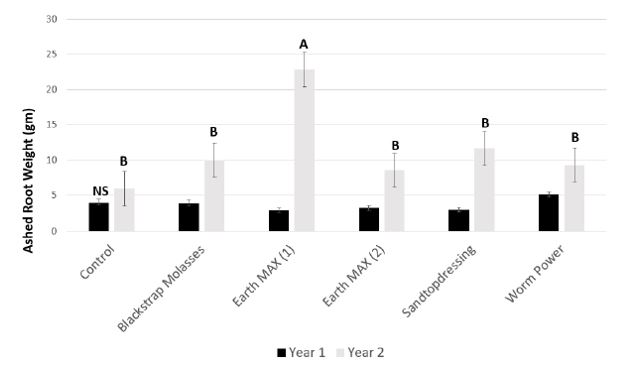
Figure 1.Turfgrass root weight for two 16-week thatch control greenhouse studies. Means followed by the same letter within each year are not significantly different according to Fischer's protected LSD at (a=0.10). Clemson University Greenhouse Facility, Clemson, SC.
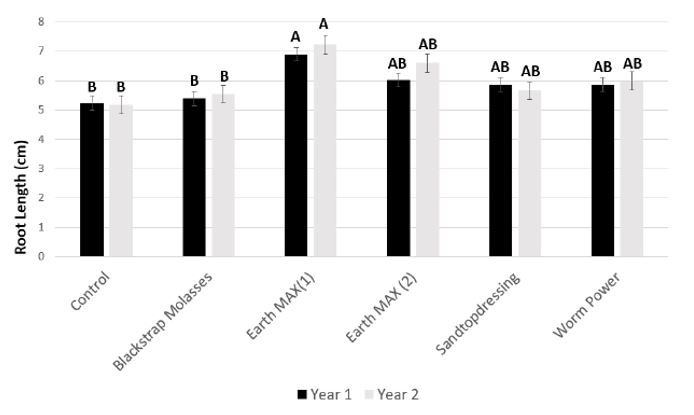
Figure 2.Turfgrass rooting length for two 16-week thatch control field studies. Means followed by the same letter within each plot are not significantly different according to Fisher's protected LSD (a=0.10). The Walker Golf Course, Clemson, SC.
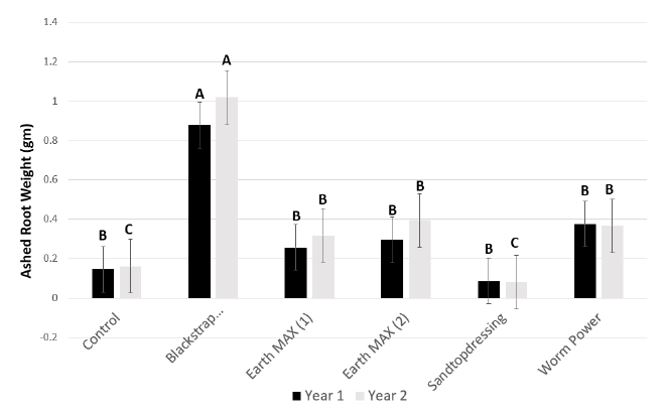
Figure 3.Turfgrass root weight for two 16-week thatch control field studies. Means followed by the same letter within each eary are not significantly different according to Fisher's protected LSD (a=0.10). The Walker Golf Course, Clemson, SC.
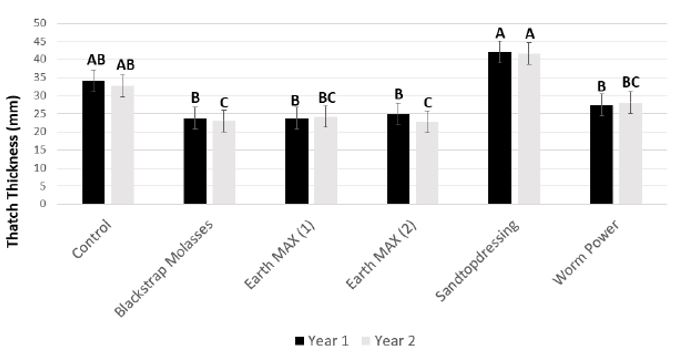
Figure 4.Turfgrass thatch thickness for two 16-week thatch control field studies. Means followed by the same letter are not significantly different according to Fisher's protected LSD (a=0.10). The Walker Golf Course, Clemson, SC.
While not a replacement for core aeration, verticutting, or topdressing, incorporating a material such as EarthMAX® or blackstrap molasses into a soil management program should be considered. The benefit of a compost extract such as EarthMAX® or blackstrap molasses, such as what’s contained in Soil Enhancer, has been demonstrated through research, including the study above. If you’re interested in learning more or want to find out how EarthMAX® is being implemented by Superintendents in your area, I encourage you to reach out to your Harrell’s rep. If you’re interested in reading more about the study mentioned above, I encourage you to review the full study on Golf Course Magazine.
References:
Ledeboer, FB, CR Skogley. 1967. Investigations into the nature of thatch and methods for its decomposition. Agronomy Journal. 59:320-323.
Weaver, JR. 2020. Evaluation of Biological Thatch Control on Golf Greens. Dissertation. Clemson University, Clemson S.C. (https://tigerprints.clemson.edu/all_dissertations/2610/? utm_source=tigerprints.clemson.edu%2Fall_dissertations%2F2610&utm_medium=PDF&utm_campaign=PDFCoverPages)
Weaver, JR, LB McCarty. 2020. Evaluating biological thatch control in turfgrass. (https://www.gcmonline.com/latest-stories/biological- thatch-control-turfgrass). Accessed Jan. 21st, 2021.
Related Resources

In addition to being the nation’s largest distributor of branded fungicides, herbicides, and insecticides, Harrell’s produces custom-blended fertilizers, specialty liquids, and wetting agents. Additionally, Harrell’s is the exclusive US owner, formulator, and distributor of all POLYON® branded products.
TEAM HARRELL'S
STAY EQUIPPED
Never stop learning. Access FREE continuing education courses from Harrell’s.
LET'S GROW
PRESS RELEASES
PRESS RELEASES
STAY EQUIPPED
Never stop learning. Access FREE continuing education courses from Harrell’s.
LET'S GROW