

Balanced Approach is a Home Run
4/17/2019 - By Mary Eisner
Set among the historic tobacco warehouses of downtown Durham, North Carolina, resides the home of the Durham Bulls triple-A minor league baseball team. Designed to reflect the charm of old-time baseball parks, the Durham Bulls Athletic Park incorporates a brick motif throughout the stadium, offers terrific views from each of the 10,000 comfortable seats, and has a 32-foot high “Blue Monster” wall in left field complete with an iconic towering bull mounted on top.
As with all outdoor stadiums, weather plays a challenging role in the maintenance and upkeep of the facility, predominantly the health and endurance of the athletic turf. Scott Strickland, the Assistant General Manager of Operations for the Durham Bulls, has experienced firsthand the rough turf transitions on his baseball field as the winter ryegrass dies off and the summer bermudagrass takes over. One especially challenging year was back in 2013 when they hosted the ACC tournament. Over the course of 5 days, they hosted 15 games (including a game that lasted 15 innings!). By the end of the week the field was completely worn down. When the Championship game aired on National Television that Sunday, Scott was embarrassed by the poor condition of his field. He acknowledged, “people understand because they know you’ve had 15 games in 5 days, but that doesn’t excuse the fact that you want to have higher standards than that.” When the Durham Bulls Athletic Park signed a 7-year partnership with Duke baseball, Scott knew this would skyrocket the wear and tear his turf needed to endure as the Duke baseball team played all their home games on his field. Armed with his desire for perfection and the courage to explore unchartered territory, Scott decided to forego the customary practice of overseeding his sports turf and along the way he and his team discovered some remarkable results.
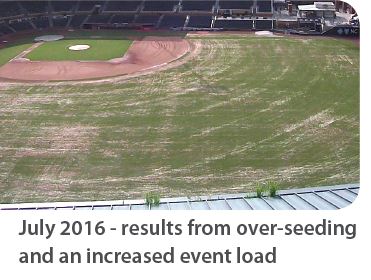
In the Fall of 2014 the Durham Bulls stadium was renovated, which included a new surface for the field. Knowing he had a year before the Duke arrangement would officially begin, Scott used that time to try and grow in the Bermuda turf a little bit more. Scott recalls one of the oddest things they ever did, “we actually went out and about 14 days after we overseeded, we killed all of that.” Scott admits, “I’m a traditionalist, I get very afraid of trying new things so that was a leap of faith for me. But I knew if we didn’t try it we would never know what we could get away with and what the benefits would be.” Going into the 2015 season, Scott and his team had surprising success with this new method. Notwithstanding, they went back to overseeding for the 2016 season as they also took on the increased event load of hosting the Duke baseball home games. When the middle of summer rolled around Scott was once again disappointed with the state of his turf and he was struck with the thought that there must be a better way.
Motivated by his experience of not overseeding for the 2015 season, Scott began working on a plan of action for 2017 with Waldo Terrell, his Harrell’s Territory Manager. “He’s pretty much been our go-to guy for all of [this],” explains Scott. “It’s neat what that has turned into, it’s more than just a consultant and a sales person, it’s constant communication on what’s happening with our facility or our other buddies around the area and things that they’re doing and things they’ve succeeding with. That’s been the great part of our relationship with him, he’s able to provide, not just answers for us, but he’s able to provide answers that have happened elsewhere that could potentially be answers for us. He’s also turned into a really good friend.” The Durham Bulls stadium hosts approximately 86 events between February and June. For a lot of baseball stadiums, 86 events are the total amount of events they have for the entire year, but Scott and his team get that done before summer has even arrived! Scott emphasized that, “it’s incredibly important that we have a healthy, durable plant, that’s got the reserves and that’s got the products to fight through the event load that we put on it.” Utilizing a Balanced Approach model that Waldo had previously worked on with another customer, Scott was able to develop a program that incorporated the use of grow blankets, was flexible around specific event dates and could handle the heavy event load. And then he and Cameron Brendle, the Sports Turf Manager, courageously rolled with that program throughout the 2017 season.
Scott knew he had to be very proactive in his approach to turf health, and the Balanced Approach program gave him all the tools necessary to do that. He explains, “the success in March starts in Sept and Oct, making sure you’re giving that bermudagrass plenty of reserves before it goes dormant. So, when it is told, whether that be naturally or fictitiously by blankets, that ‘hey it’s time to wake up’, it’s got what it needs to wake up as efficiently and quickly as possible. If we don’t do anything in the fall and it just warms up in March, then it would not kick as much as we need it to.” One of the keys to his success has been the use of POLYON® controlled-release fertilizer.
“We are big believers in POLYON®. Our thinking, especially with the non-overseeding, is we have that product out, it’s sitting there, and when the plant wants to use it, we know it’s got something to use. We know we’re never going to get to a point in which it doesn’t have any food whatsoever. And then obviously the benefits of not having to walk/spread. There’s a lot of events, we work a lot of hours just facilitating those events. We get a lot of value out of having a product that’s going to last for 10-12 weeks that we don’t have to keep reapplying. That’s a tremendous value to us. When our events get over we want to go home and go to bed.”
When the weather in North Carolina begins to warm up, Scott pays close attention to the forecast and the state of his dormant turf before making his move. It’s a delicate process, as Scott explains, “We gauge the time of year and what that 10-day forecast looks like. And once we get green up out of that bermudagrass, whether that be naturally from the temperatures or that be cheating it with the combination of the grow blankets and some paint to help warm it up. We don’t push it hard, but we push it a little bit, because if it’s green and it’s starting to grow, the terminology we use is ‘it’s wanting to eat, and we need to give it something to eat.’ And so we need to spoon-feed it at that point, and that’s where the foliar program just comes in so much where we can spoon feed, we can back off, we can bump up a little bit here, back off a little bit here, depending on what temperatures are going to do, because obviously we don’t want to push it too much knowing that we probably will get another couple frosts as we navigate that first half of March. And then once we get to the middle of March it’s on. We’re pumping once a week to get it going, to get it through our heavy event load, which basically takes us to the end of the first week of June.”
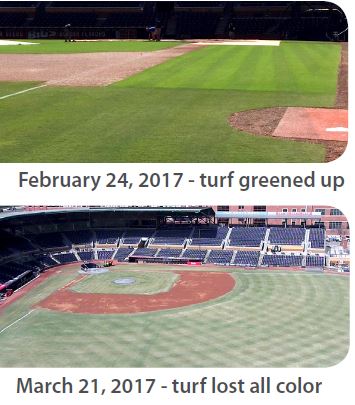
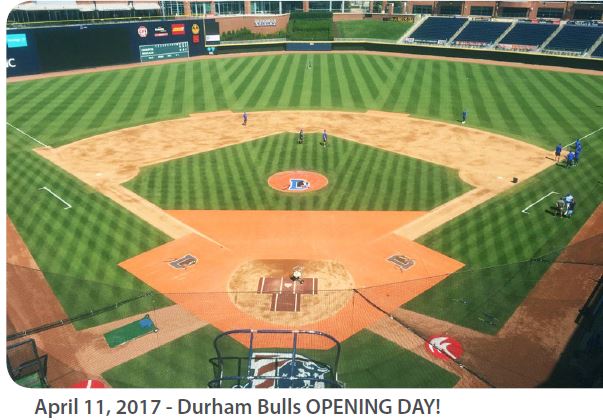
On February 24, 2017, Scott was pleased to see that his field had greened up beautifully. But with a big event load and several cold fronts and frosts, the field looked terrible by March 21, 2017 – and the team was scheduled to report in just 11 days. Scott did not panic, the Balanced Approach program had prepared him for this moment. Over the next 10 days Scott and his team worked their magic. Scott recalls, “We applied a light, light coating of about 12 tons of green sand, and our thought process there was we are trying to attract as much heat as we possibly can. We played that last Duke game on a Tuesday, the sand was already out, as soon as the game was over we covered it up with the blankets and the blankets stayed on for between 5-6 days and we got really lucky with temperatures. We were around 72 and 73 degrees outside air temperature and then that’s what we were pumping underneath the blankets. The green sand, the warmth that was natural, the warmth that was created by the blankets, all led to that success in addition to obviously having the fertilizer products and the POLYON® and everything already sitting there, the plant was already juiced up and ready to rock and roll. It perfectly came together: it had the fertility, it had the warmth, it had the days off, it had all the conditions it needed to thrive.” When March 31, 2017 rolled around, the field was in textbook condition, and opening day for the Durham Bulls was picture-perfect.
 Scott explains why he and his team don’t ever envision going back to an overseeding program, “we are 100% convinced that we can get away with it, we can get by those February days where it’s really cold, using some pigments and grow blankets, we can get through those times and we can maximize when it is warm enough. We are convinced it’s the way to go.” To those eager to develop a personalized Balanced Approach program for their own agronomic needs, Scott advises, “you constantly have to watch that forecast with what we’re trying to do, and you’ve got to be prepared, you’ve got to have products on the shelf ready and waiting. Some of the products you use might not make sense for that time of year, but the weather conditions and the event load might dictate that. So, you’ve got to be really, really flexible. It’s a really fluid process when you’re getting that tight to opening day. You’ve got to be green, you’ve got to be opening day ready. You’ve got to have all those supplies either on the shelf or already in the plant, or else you’re not going to be able to succeed and meet your goals.”
As people witness the phenomenal results Scott has achieved, they are more and more willing to take the same risk. Scott laughs as he recalls a few of his colleagues at the beginning of 2018, “it’s funny, everyone is going through the same emotions that we went through the first year. Their General Manager is freaking out right now, nervous as can be, but in another month and a half he’ll be jumping for joy.” Scott knows that once they reach April and May, they will all echo his sentiments from 2017. Looking around the lush and picture-perfect field, he shook his head and said, “It’s literally at the point where you say ‘why didn’t we do this earlier? Why have we been stuck in our old ways for so long?’”
Ubicado entre los históricos almacenes de tabaco del centro de Durham, Carolina del Norte, se encuentra el hogar del equipo de béisbol de las ligas menores A de Durham Bulls. Diseñado para reflejar el encanto de los antiguos parques de béisbol, el Durham Bulls Athletic Park incorpora un motivo de ladrillo en todo el estadio, ofrece vistas espectaculares de cada uno de los 10,000 asientos cómodos y tiene un muro de "Monstruo azul" de 32 pies de altura en la izquierda. campo completo con un toro torres icónico montado en la parte superior.
Al igual que con todos los estadios al aire libre, el clima juega un papel desafiante en el mantenimiento y el mantenimiento de las instalaciones, predominantemente en la salud y la resistencia del césped atlético. Scott Strickland, el Subdirector General de Operaciones de los Durham Bulls, ha experimentado de primera mano las duras transiciones de su campo de béisbol cuando el césped rye de invierno se apaga y el césped bermuda de verano toma el control.
Un año especialmente desafiante fue en 2013 cuando se celebró el torneo ACC. En el transcurso de 5 días, organizaron 15 juegos (incluido un juego que duró 15 entradas). Al final de la semana, el campo estaba completamente desgastado. Cuando el juego del Campeonato salió al aire en la Televisión Nacional ese domingo, Scott se sintió avergonzado por las malas condiciones de su campo.
Reconoció que "la gente entiende porque saben que has tenido 15 juegos en 5 días, pero eso no justifica el hecho de que quieras tener estándares más altos que eso". Cuando el Durham Bulls Athletic Park firmó una asociación de 7 años con el béisbol de Duke, Scott sabía que esto aumentaría considerablemente el desgaste que su césped necesitaba para soportar mientras el equipo de béisbol de Duke jugaba todos sus partidos en casa en su campo. Armado con su deseo de perfección y el coraje de explorar un territorio desconocido, Scott decidió renunciar a la práctica habitual de resiembra (overseeding) su césped deportivo y, a lo largo del camino, él y su equipo descubrieron algunos resultados notables.
En el otoño de 2014 se renovó el estadio Durham Bulls, que incluía una nueva superficie para el campo. Sabiendo que tenía un año antes de que comenzara oficialmente el acuerdo con Duke, Scott aprovechó ese tiempo para intentar crecer en el terreno de las Bermudas un poco más. Scott recuerda una de las cosas más extrañas que hicieron en su vida, "salimos y 14 días después de haber sobrevalorado, matamos todo eso". Scott admite: "Soy tradicionalista, tengo mucho miedo de probar cosas nuevas. Eso fue un salto de fe para mí. Pero sabía que si no lo intentáramos, nunca sabríamos de qué podríamos escapar y cuáles serían los beneficios ".
Al comenzar la temporada 2015, Scott y su equipo tuvieron un éxito sorprendente con este nuevo método. No obstante, volvieron a la resiembra (overseeding) para la temporada 2016, ya que también asumieron la mayor carga de eventos de los juegos de béisbol de Duke en casa. Cuando llegó la mitad del verano, Scott se decepcionó una vez más con el estado de su territorio y se sorprendió al pensar que debía haber una mejor manera.
Motivado por su experiencia de resiembra para la temporada 2015, Scott comenzó a trabajar en un plan de acción para 2017 con Waldo Terrell, su Gerente de Territorio de Harrell. "Ha sido prácticamente nuestro hombre al que acudimos para todo [esto]", explica Scott. "Es genial en lo que se ha convertido, es más que solo un consultor y un vendedor, es una comunicación constante sobre lo que está sucediendo con nuestras instalaciones o nuestros otros amigos en el área y las cosas que están haciendo y las cosas con las que han tenido éxito". Esa ha sido la gran parte de nuestra relación con él, él puede proporcionarnos, no solo respuestas para nosotros, sino que puede proporcionar respuestas que han sucedido en otros lugares que podrían ser respuestas para nosotros. También se ha convertido en un muy buen amigo ".
El estadio Durham Bulls alberga aproximadamente 86 eventos entre febrero y junio. Para una gran cantidad de estadios de béisbol, 86 eventos son la cantidad total de eventos que tienen durante todo el año, ¡pero Scott y su equipo lo hacen antes de que llegue el verano! Scott enfatizó que, "es increíblemente importante que tengamos una planta saludable y duradera, que tenga las reservas y los productos para luchar contra la carga de eventos que le asignamos.
"Utilizando un modelo de enfoque equilibrado en el que Waldo había trabajado anteriormente con otro cliente, Scott pudo desarrollar un programa que incorporaba el uso de mantas de cultivo, era flexible con respecto a las fechas de eventos específicos y podía manejar la gran cantidad de eventos. Y luego él y Cameron Brendle, el Gerente de Césped Deportivo, valientemente actuaron con ese programa a lo largo de la temporada 2017.
Scott sabía que tenía que ser muy proactivo en su enfoque de la salud del césped, y el programa de Enfoque equilibrado (Balanced Approach program) le dio todas las herramientas necesarias para hacerlo. Él explica, "el éxito en marzo comienza en septiembre y octubre, asegurándose de que le está dando a ese césped bermuda un montón de reservas antes de que permanezca latente. Entonces, cuando se le dice, ya sea de manera natural o ficticia por las mantas, que "oye, es hora de despertar", tiene lo que necesita para despertarse de la manera más eficiente y rápida posible. Si no hacemos nada en el otoño y solo se calienta en marzo, entonces no funcionará tanto como lo necesitamos”. Una de las claves de su éxito ha sido el uso POLYON® controlled-release fertilizer.
“Somos grandes creyentes en POLYON®. Nuestro pensamiento, especialmente en el caso de la falta de resiembra, es que tenemos ese producto fuera, está ahí sentado, y cuando la planta lo quiere usar, sabemos que tiene algo que usar. Sabemos que nunca vamos a llegar a un punto en el que no tenga ningún tipo de alimento. Y luego, obviamente, los beneficios de no tener que caminar / propagarse.
Hay muchos eventos, trabajamos muchas horas simplemente facilitando esos eventos. Obtenemos mucho valor de tener un producto que va a durar de 10 a 12 semanas que no tenemos que seguir solicitando. Eso es un tremendo valor para nosotros. Cuando nuestros eventos terminen, queremos ir a casa e ir a la cama ".
Cuando el clima en Carolina del Norte comienza a calentarse, Scott presta mucha atención al pronóstico y al estado de su césped inactivo antes de hacer su movimiento. Es un proceso delicado, como Scott explica, "Evaluamos la época del año y el aspecto de ese pronóstico de 10 días. Y una vez que obtengamos el color verde del césped bermuda, ya sea naturalmente debido a las temperaturas o que lo estén engañando con la combinación de las mantas de cultivo y un poco de pintura para ayudar a calentarlo.
No lo presionamos con fuerza, pero lo presionamos un poco, porque si está verde y está empezando a crecer, la terminología que utilizamos es "quiere comer, y tenemos que darle algo de comer". Necesitamos alimentarlo con una cuchara en ese punto, y ahí es donde el programa foliar viene tanto donde podemos alimentar con una cuchara, podemos retroceder, podemos subir un poco aquí, retroceder un poco aquí, dependiendo sobre qué temperaturas van a hacer, porque obviamente no queremos presionar demasiado sabiendo que probablemente tendremos otro par de heladas mientras navegamos en la primera mitad de marzo. Y luego, una vez que llegamos a mediados de marzo, está encendido. Estamos bombeando una vez a la semana para ponerlo en marcha, para superar nuestro gran volumen de eventos, que básicamente nos lleva al final de la primera semana de junio ".
El 24 de febrero de 2017, a Scott le complació ver que su campo se había mejorado maravillosamente. Pero con una gran carga de eventos y varios frentes fríos y heladas, el campo se veía terrible para el 21 de marzo de 2017, y el equipo tenía un informe programado en solo 11 días. Scott no se asustó, el programa de Enfoque equilibrado lo había preparado para este momento. Durante los siguientes 10 días, Scott y su equipo trabajaron su magia. Scott recuerda: “Aplicamos una capa ligera y liviana de aproximadamente 12 toneladas de arena verde, y en nuestro proceso de pensamiento intentamos atraer la mayor cantidad de calor posible.
Jugamos ese último juego de Duke un martes, la arena ya estaba fuera, tan pronto como terminó el juego, lo cubrimos con las mantas y las mantas se mantuvieron durante 5-6 días y tuvimos mucha suerte con las temperaturas. Teníamos alrededor de 72 y 73 grados fuera de la temperatura del aire y eso es lo que bombeamos debajo de las mantas. La arena verde, el calor que era natural, el calor que crearon las mantas, lo llevaron a ese éxito, además de tener obviamente los productos fertilizantes y el POLYON® y todo lo que ya estaba allí, la planta ya estaba lista y preparada. para rock & roll. Se combinó perfectamente: tenía la fertilidad, tenía el calor, tenía los días de descanso, tenía todas las condiciones que necesitaba para prosperar”. Cuando el 31 de marzo de 2017 comenzó a funcionar, el campo estaba en condición de libro de texto y día de apertura. Para los Durham Bulls fue una imagen perfecta.
Scott explica por qué él y su equipo nunca imaginan volver a un programa de resiembra, "estamos 100% convencidos de que podemos salir adelante, podemos llegar a esos días de febrero en los que hace mucho frío, usando algunos pigmentos y mantas de creciendo", podemos atravesar esos tiempos y podemos maximizar cuando hace suficiente calor. Estamos convencidos de que es forma de hacerlo.
"Para aquellos ansiosos por desarrollar un programa personalizado de Enfoque equilibrado para sus propias necesidades agronómicas, Scott aconseja: "constantemente tiene que observar ese pronóstico con lo que estamos tratando de hacer, y tiene que estar preparado, debe tener los productos en el estante listos y esperando. Es posible que algunos de los productos que use no tengan sentido para esa época del año, pero las condiciones climáticas y la carga de eventos podrían dictarlo. Entonces, tienes que ser muy, muy flexible. Es un proceso realmente fluido cuando está tan cerca del día de apertura. Tienes que estar verde, tienes que estar listo para el día de apertura. "Debes tener todos esos suministros en el estante o ya en la planta, o de lo contrario no podrás tener éxito y cumplir tus objetivos".
A medida que las personas son testigos de los resultados fenomenales que Scott ha logrado, están cada vez más dispuestos a correr el mismo riesgo. Scott se ríe cuando recuerda a algunos de sus colegas a principios de 2018, "es gracioso, todos estamos pasando por las mismas emociones que vivimos el primer año. Su director general se está volviendo loco en este momento, por muy nervioso que esté, pero dentro de un mes y medio más estará saltando de alegría ". Scott sabe que una vez que lleguen a abril y mayo, todos se harán eco de sus sentimientos a partir de 2017. Alrededor del campo exuberante y con una imagen perfecta, sacudió la cabeza y dijo: "Es literalmente en el punto en el que dices '¿por qué no hicimos esto antes? ¿Por qué hemos estado estancados en nuestras viejas costumbres durante tanto tiempo? "
Authored by Mary Eisner
Related Resources

In addition to being the nation’s largest distributor of branded fungicides, herbicides, and insecticides, Harrell’s produces custom-blended fertilizers, specialty liquids, and wetting agents. Additionally, Harrell’s is the exclusive US owner, formulator, and distributor of all POLYON® branded products.
TEAM HARRELL'S
STAY EQUIPPED
Never stop learning. Access FREE continuing education courses from Harrell’s.
LET'S GROW
PRESS RELEASES
PRESS RELEASES
STAY EQUIPPED
Never stop learning. Access FREE continuing education courses from Harrell’s.
LET'S GROW